
Every municipality already has thousands—or millions—of eyes and ears distributed throughout the community.
They belong to the residents, visitors and employees who move through the city every day.
Spime connects them directly to municipal operations.
When someone encounters a pothole, water leak, damaged sign, illegal dumping, traffic hazard or other concern, they simply capture a photo or video through the Spime mobile app.
The location, time and visual context come with it.
The result is a remarkably simple connection between what is happening on the street and the people responsible for keeping the city running.
The eyes and ears are already there. Spime connects them to the City.
Table of Contents
Reporting Should Be This Simple
See it. Capture it. Done.
Residents shouldn't need to understand the organizational structure of their municipality just to report a problem.
They shouldn't have to determine which department is responsible, search through municipal websites, manually enter an address or compose a detailed explanation of something they can simply show you.
With Spime, the person is already standing in front of the issue.
They take a photo or video. Spime does the rest.
Location and time are captured automatically. The report arrives through the municipal Spime, where it can be reviewed, categorized and acted upon by authorized personnel.
Less effort for the resident.
Better information for the City.
Thousands of Eyes and Ears
The cameras are already on the ground.
A municipality cannot place staff everywhere.
But its residents and visitors already are everywhere.
Spime transforms smartphones already distributed throughout the community into a network of human-operated, real-time sensors.
A resident notices a damaged road.
A visitor encounters a dangerous condition.
Someone sees a water leak before municipal personnel know it exists.
Another person documents illegal dumping while still at the location.
Each participant can become another source of immediate situational awareness.
The larger the community, the more powerful the network becomes.
Authentic Information From the Ground
Captured there. Captured now.
When a municipality receives information from the public, knowing where and when it originated matters.
Spime does not allow users to upload existing photos or videos into a Spime.
Media must be captured directly through the Spime camera while the participant is physically within the permitted geographic area.
That means the municipality isn't simply receiving an image someone says came from a particular location.
It is receiving visual information captured through Spime, on the ground, within the relevant Space-Time context.
For municipal operations, that provides valuable confidence and context from the very beginning.
Municipal Operations Command Center
From thousands of eyes on the ground to one coordinated operational view.
Citizen participation is only valuable if the municipality has the infrastructure to see it, organize it and act on it.
The Spime Municipal Operations Command Center provides that operational layer.
Incoming activity from across the municipality can be monitored from a centralized environment, giving authorized teams a real-time view of what residents and visitors are reporting throughout the city.
From there, personnel can assess incoming information, create tickets, assign responsibility, communicate directly with citizens and follow each issue through to resolution.
The mobile app puts thousands of eyes on the ground.
The Command Center brings what they see into one operational view.
One Platform. From Capture to Resolution.
Capture → Monitor → Assess → Assign → Communicate → Resolve → Track
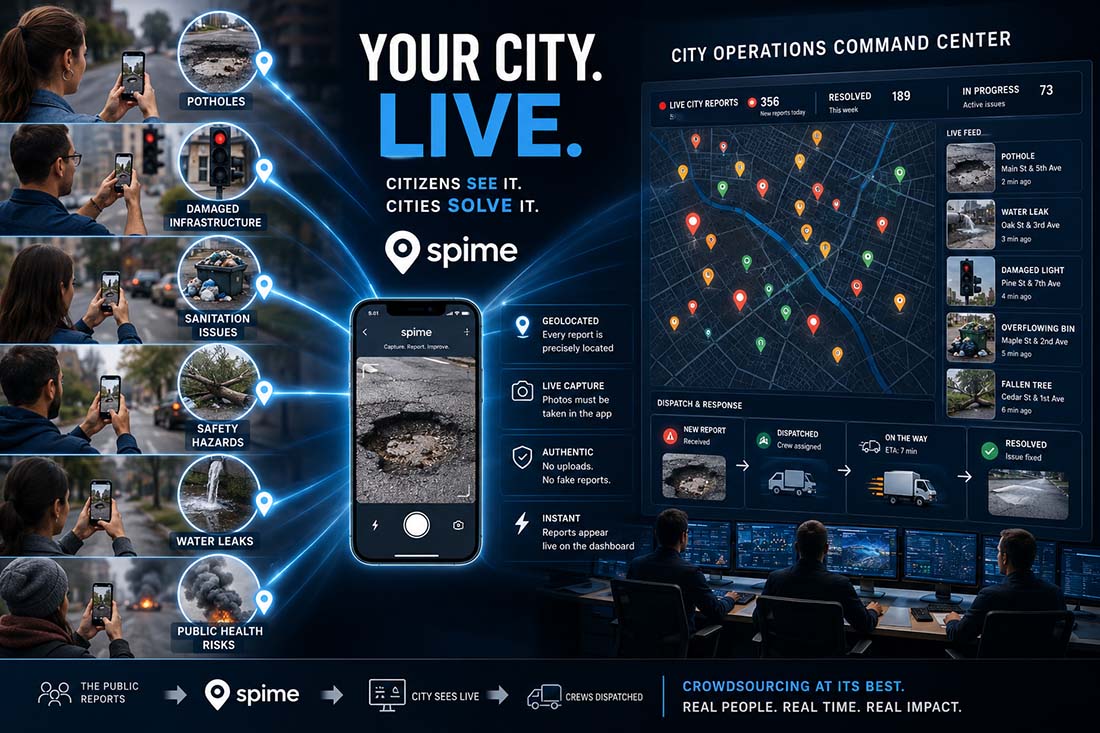
See how citizen participation, municipal teams and operational workflows connect through the Spime Municipal Operations Command Center. Click to enlarge
From Report to Resolution
Turn incoming information into action.
When a report reaches the Command Center, authorized personnel can turn it into a structured operational ticket and direct it to the appropriate department, employee, agency or other responsible party.
The ticket remains connected to its activity and communications as it moves through the organization, creating a traceable path from the original observation through to resolution.
Municipal teams can:
- Review incoming photos, videos and location information
- Categorize and prioritize issues
- Create and assign tickets
- Escalate issues when necessary
- Communicate directly with the reporting citizen
- Track progress and activity
- Follow issues through to resolution
- Maintain a history of actions and communications
What begins with a citizen seeing something becomes an accountable municipal workflow.
The Citizen Stays Connected
Reporting shouldn't feel like sending information into a black hole.
One of the frustrations citizens experience with conventional reporting systems is uncertainty.
Was the report received?
Did anyone see it?
Is something being done?
Spime creates the opportunity for a much more direct relationship.
Municipal personnel can communicate with the citizen who submitted the report, request additional information when necessary and keep communication connected to the issue being addressed.
Residents can see that their participation matters.
The municipality gains something equally valuable: a community that becomes more willing to participate because people can see that participation leads to action.
Organize What the City Needs to See
Your priorities. Your categories.
Every municipality has different operational priorities.
Spime allows municipal Clients to define Tags that help categorize activity and guide citizen reporting.
Examples might include:
Potholes · Parking · Water Leaks · Traffic · Waste · Public Safety · Parks · Accessibility · Animal Welfare · Environmental Issues
A municipality can establish categories appropriate to its own departments, services and local priorities.
Emergency Tags can also identify situations requiring immediate attention and notification.
Citizens don't need to understand which department ultimately owns the issue.
They report what they see. The municipality manages what happens next.
One City. Many Departments. One Operational View.
Municipal issues rarely belong to a single team.
Public Works may handle one report. Transportation another. Parks, By-law Enforcement, Waste Management or an outside contractor may be responsible for the next.
Spime provides a common operational layer through which incoming information can be assessed and directed to the appropriate people while maintaining visibility over the complete lifecycle of the issue.
Departments can retain their individual responsibilities without forcing citizens to navigate the organizational structure behind them.
One point of participation for the citizen. The right destination inside the City.
Applications Across the Municipality
One platform can serve many municipal priorities.
Infrastructure & Public Works
Potholes, damaged roads, sidewalks, streetlights, water leaks, signage, construction issues and other infrastructure concerns.
Traffic & Transportation
Traffic hazards, parking concerns, road obstructions, damaged infrastructure and transportation-related issues.
Environmental Services
Illegal dumping, pollution, waste management, environmental hazards, park conditions and animal welfare concerns.
Public Safety
Unsafe conditions, fire hazards, damaged public infrastructure and other situations requiring timely awareness.
Parks & Public Spaces
Maintenance concerns, damaged facilities, accessibility issues and conditions affecting community spaces.
Community Engagement
Public feedback, community improvement initiatives, consultations and programs that invite residents to participate directly in their city.
Tourism & Events
Municipal events, festivals, cultural activities and destination Spimes that allow residents and visitors to collectively capture and experience what is happening.
Emergency & Disaster Response
Real-time visual information from people already distributed throughout affected areas can provide another layer of situational awareness during rapidly developing events.
More Than Issue Reporting
A direct Space-Time channel with your community.
The same Spime infrastructure used to report a pothole can do much more.
A municipality can create Spimes around festivals and community events.
Tourism departments can create destination Spimes.
Public consultations can invite participation around specific places or initiatives.
Emergency teams can establish Spimes around developing situations.
Community programs can use Spime to connect residents around local activities.
Spime therefore isn't simply another municipal reporting application.
It is a real-time engagement layer between a municipality and the people physically present throughout it.
Local Operation or Centralized Deployment
Spime can scale beyond a single municipality.
A municipality can operate Spime independently through its own Municipal Operations Command Center.
But it doesn't have to.
Regional authorities, ministries, provincial or state governments, and other higher-level organizations can deploy Spime across multiple municipalities and centralize monitoring through a shared Operations Command Center.
Incoming activity can be assessed centrally and tickets distributed to the appropriate municipality, department, agency or other responsible organization.
This can reduce the need for every municipality to independently duplicate the same monitoring infrastructure while preserving responsibility at the local level.
Centralized visibility. Distributed responsibility. Local action.
Better Information. Better Operations. Stronger Communities.
What Spime can bring to municipal government.
Earlier Awareness
Issues can be identified by the people who encounter them—potentially before municipal personnel would otherwise become aware of them.
Better Information
Location, time and visual context accompany reports from the beginning, reducing ambiguity and unnecessary back-and-forth.
Faster Response
Incoming information can move directly into structured workflows and be assigned to the appropriate responsible team.
Greater Accountability
Tickets, communications, actions and outcomes can remain connected within a traceable operational history.
Increased Transparency
Citizens gain greater visibility that their concerns have been received and are being acted upon.
More Efficient Operations
A centralized environment connects citizen reporting, monitoring, communication and ticket management rather than scattering them across disconnected channels.
Stronger Citizen Engagement
Residents become active participants in identifying and improving the conditions of their community.
Your City Doesn't Need More Eyes.
It needs to connect the ones already there.
Every day, thousands of people move through your streets, parks, neighbourhoods and public spaces.
They see what is happening.
Spime gives them a remarkably simple way to show you.
And it gives your municipality the operational infrastructure to turn what they see into action.
Your City. Live. Citizens see it. Cities solve it.
Explore Spime for Your Municipality
Every city has different priorities, departments and operational needs.
Let’s explore how Spime can work for yours.
We would be happy to demonstrate the complete citizen-to-resolution workflow and discuss how Spime could integrate with your municipality's existing operational structure.